

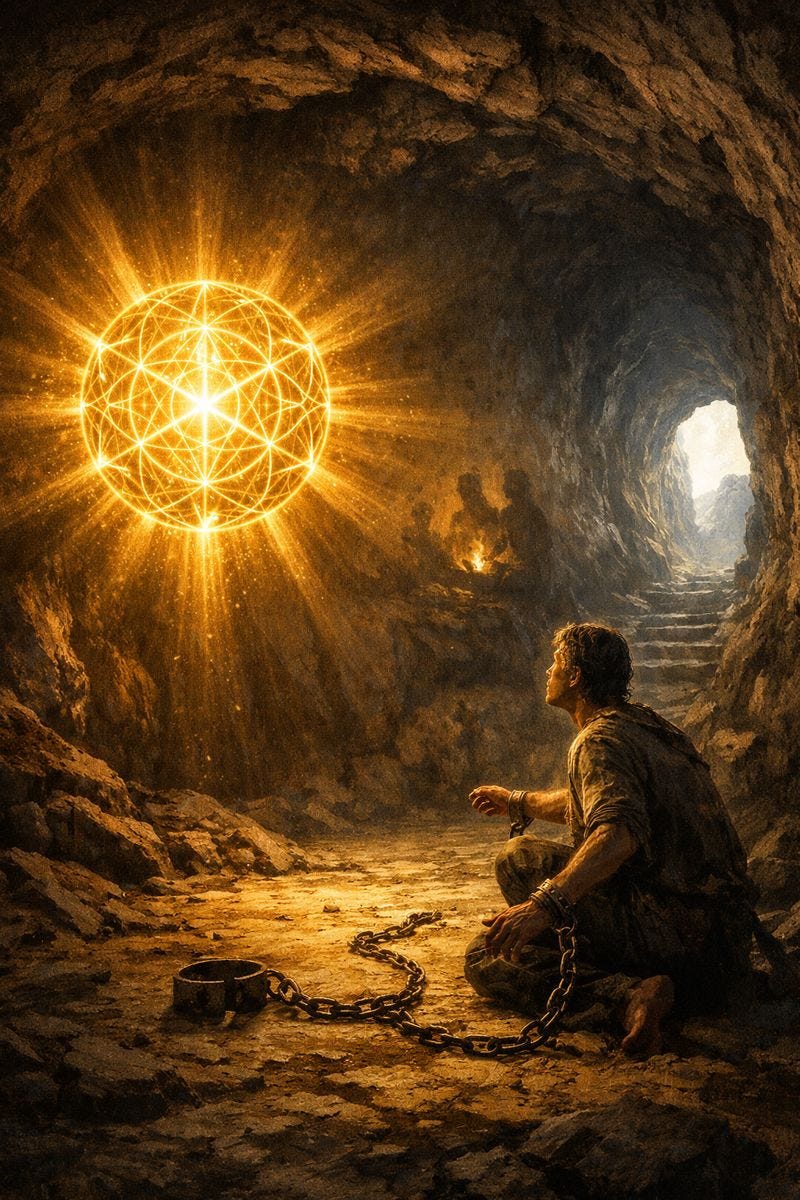
Across the history of Indo-European and related philosophical traditions, human existence has been understood not primarily as linear progress but as repetition, recurrence, and return. From the Greek myth of successive age and the transmigration of souls of Pythagoras and Plato, to the Hindu doctrine of yugas and samsara, to the ritual regenerations analyzed by Mircea Eliade, time appears as cyclical, heavy with necessity, and resistant to final resolution. Within such systems, the central existential problem is not merely suffering, but rather the question of how a finite being is to live when existence repeats, decays, or returns upon itself without the ultimate guarantee of progress and the entropy of nihilism. The answer repeatedly given by these traditions is heroism, the idea that life’s weight must be confronted actively, courageously, and transformatively. Hesiod’s Works and Days famously outlines the decline from the Golden Age to the Iron Age, situating humanity in a fallen cycle marked by toil and injustice. In India, the doctrine of the yugas similarly describes a cosmic degeneration culminating in the Kali Yuga, an age of spiritual exhaustion and moral ruin. Yet these traditions do not collapse into despair. Instead, they develop heroic and spiritual responses of ritual renewal, ascetic discipline, or divine-human struggle against chaos, as Eliade observes, archaic societies sought to escape the terror of history through ritual return to origins, thereby “abolishing profane time” and re-entering sacred, regenerative time.[1]
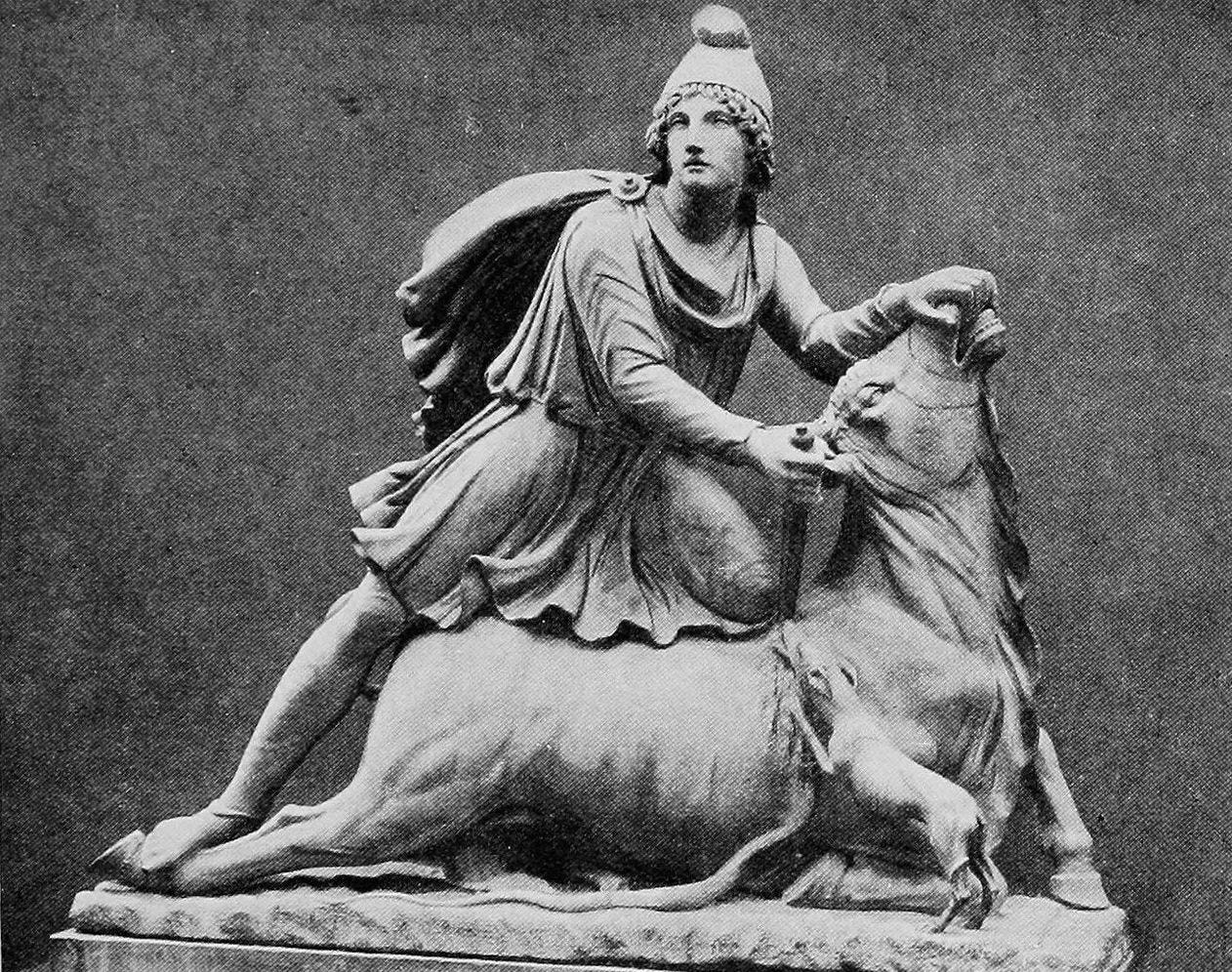
Heroism within these cyclical frameworks is not accidental. Indo-European myth repeatedly stages a confrontation between the human or divine hero and an overwhelming force of necessity or chaos: Indra slaying Vṛtra to release the waters, Heracles wrestling the Nemean lion, Mithras subduing and sacrificing the bull in the tauroctony. These myths encode a single structure: the world does not improve by comfort or avoidance, but by struggle. The hero does not escape the cycle; he masters it through action, often at great personal cost. In this sense, heroism functions as a metaphysical response to cyclical time, an assertion of meaning within recurrence rather than a denial of it. It is precisely this ancient structure that Friedrich Nietzsche radicalizes and internalizes in his doctrine of the Eternal Return, as in The Gay Science, Nietzsche presents the famous thought experiment of the demon:
What if some day or night a demon were to steal after you into your loneliest loneliness and say to you: ‘This life as you now live it and have lived it, you will have to live once more and innumerable times more; and there will be nothing new in it…’ Would you not throw yourself down and gnash your teeth and curse the demon who spoke thus?[2]
The question is not cosmological but existential: can one affirm one’s life so completely that one would will its infinite repetition? Nietzsche’s challenge echoes ancient cyclical cosmologies, but it strips them of metaphysical consolation. There is no karmic progress, no escape into moksha, no ascent of the soul beyond the world. Instead, recurrence of historical entropy is compressed into a single life, transforming the cosmic cycle into a psychological and ethical trial. Crucially, Nietzsche frames this challenge as a confrontation with a demon, a figure that may be productively read in light of the Platonic concept of the daimon. In Plato, the daimon is not evil but intermediary, a guide of the soul. Socrates famously claims to be guided by his daimonion, an inner voice that restrains and directs him toward his proper path.[3] Read this way, Nietzsche’s demon is not a tempter toward despair but a summons to greatness: an inner guide that forces the individual to confront nihilism without illusion.
Nietzsche’s concern, therefore, is not merely metaphysical recurrence but the psychological danger it poses. If life endlessly repeats, then all external justifications of progress, salvation, historical redemption, and collapse. What remains is the temptation of nihilism. Nietzsche names this temptation explicitly in his portrayal of the Last Men, those who prefer comfort, safety, and passive happiness to struggle and self-overcoming: “They have their little pleasure for the day and their little pleasure for the night; but they have a regard for health.”[4] These figures embody what Nietzsche calls slave morality, a value system that anesthetizes suffering rather than transforming it. Against this background, Nietzsche’s project can be read as a modern re-articulation of the ancient heroic response to cyclical existence. Where Indo-European myth externalized the struggle in gods and heroes, Nietzsche internalizes it in the psyche of the individual. Where Hindu and Platonic traditions sought liberation from the cycle through transcendence or ascent, Nietzsche demands affirmation within the cycle. The Eternal Return becomes the modern arena of heroism, and the demon, understood as a daimon, becomes the guide that tests whether the soul is capable of saying “yes” to life in its entirety.
Nietzsche’s Eternal Return and the Demon/Daimon
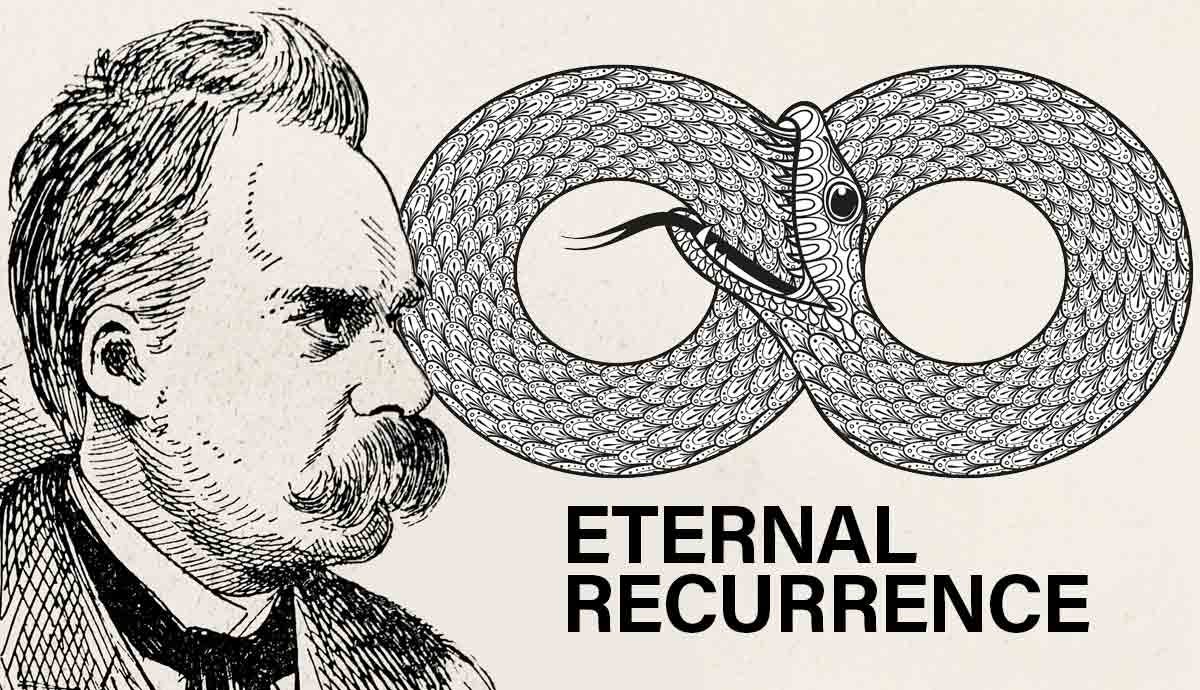
Nietzsche’s doctrine of the Eternal Return is among the most enigmatic and demanding concepts in modern philosophy. While it is sometimes treated as a cosmological hypothesis, its true force lies in its existential and psychological function. Nietzsche introduces the Eternal Return not as a scientific theory to be proven, but as a test, a confrontation designed to reveal the individual’s deepest orientation toward life itself. The figure who delivers this test is the “demon,” whose role becomes far clearer when read in dialogue with the Platonic concept of the daimon. The question Nietzsche poses of the eternal return is stark: can one affirm one’s life so fully that one would will its infinite repetition, without alteration, redemption, or escape? This formulation collapses all metaphysical hopes of progress, salvation, and reincarnational improvement into a single existential demand. Unlike Hindu samsara or Platonic transmigration, where the soul may ascend or improve across lifetimes, Nietzsche’s Eternal Return allows for no development and no transcendence. Everything returns identically. This makes Eternal Return a uniquely modern problem. It arises after the “death of God,” when transcendent sources of meaning have collapsed. Nietzsche himself frames this collapse explicitly, “God is dead. God remains dead. And we have killed him.”[5] Without divine order or teleology, the repetition of existence threatens to appear meaningless, even intolerable. The Eternal Return thus functions as the ultimate form of nihilism, but also, paradoxically, as its potential overcoming. Nietzsche writes in Thus Spoke Zarathustra that the doctrine is “the heaviest weight” a burden only the strongest spirits can bear.[6] It is here that the role of the demon becomes crucial. Nietzsche does not present the Eternal Return as an abstract proposition but as a personal confrontation delivered by a conscious interlocutor. The demon addresses the individual in their “loneliest loneliness,” the psychological space where all social, moral, and metaphysical supports have fallen away. This strongly invites comparison with the Platonic daimon, particularly as described in Plato’s account of Socrates. In the Apology, Socrates describes his daimonion as a guiding inner voice:
Something divine and daimonic comes to me… it always turns me away from something I am about to do, but never urges me toward anything.[7]
No, Demons/Daimons Are Not Evil

Western thought inherited two radically different visions of the noetic world. On one side stands the Christian cosmos of Saint Augustine, a stark, moralized landscape where all spiritual entities are either angelic servants of God or demonic enemies of the soul. On the other stands the older Platonic universe, a living hierarchy of being filled with di…
The daimon is neither god nor human, but an intermediary, an internal guide that directs the soul toward its proper orientation. Later Platonic and Neoplatonic traditions expand this idea, treating the daimon as the soul’s guardian or guide toward henosis, the return to the One.[8] Read in this light, Nietzsche’s demon is not merely a figure of terror. It is a testing guide, a daimonic presence that reveals whether the soul is capable of affirmation or collapses into ressentiment and denial. The demon does not force the Eternal Return upon the individual; it asks a question. The response of curse or affirmation reveals the soul’s strength or weakness. This interpretation aligns with Nietzsche’s repeated insistence that his philosophy is addressed only to certain types of individuals. Zarathustra explicitly states that his teaching is not for everyone: “You could not bear my doctrine: for you are not yet ripe for it.”[9] The demon, like the Platonic daimon, does not comfort or console. It confronts. It exposes. It demands an answer that cannot be deferred to doctrine, community, or hope of redemption. In this sense, the demon functions as the internalized heroic challenge once embodied in mythic monsters or cosmic antagonists. The Eternal Return, therefore, transforms the ancient heroic structure. Where Indo-European myth externalized struggle in battles against dragons, giants, or chaos-beasts, Nietzsche relocates the struggle into the psyche. The “monster” is no longer Vṛtra, the Hydra, or the bull of Mithras, but nihilism itself, the temptation to reject life because it lacks ultimate meaning or justification. The demon/daimon stands at the threshold of this struggle, asking whether the individual can affirm life without illusion. Nietzsche makes clear that the correct response to the demon is not resignation but amor fati or the love of fate:
My formula for greatness in a human being is amor fati: that one wants nothing to be different, not forward, not backward, not in all eternity.[10]
This is not passive acceptance. It is an active, heroic will of existence as it is. In affirming the Eternal Return, the individual does not escape the cycle but masters it inwardly, achieving a form of existential sovereignty. The demon, understood as a daimon, thus becomes the guide toward self-overcoming, the inner voice that calls the soul either to collapse into the comfort of illusion or to rise to the height of affirmation. In this way, Nietzsche’s Eternal Return functions as a modern, psychological transposition of ancient cyclical metaphysics. It preserves the structure of recurrence while stripping away metaphysical escape routes. The demon/daimon replaces the mythic adversary, and the battleground shifts from cosmos to consciousness. What remains unchanged is the demand for heroism: the courage to confront repetition, suffering, and meaninglessness, and to say “yes” nonetheless.
Heroism, the Übermensch, and Apotheosis
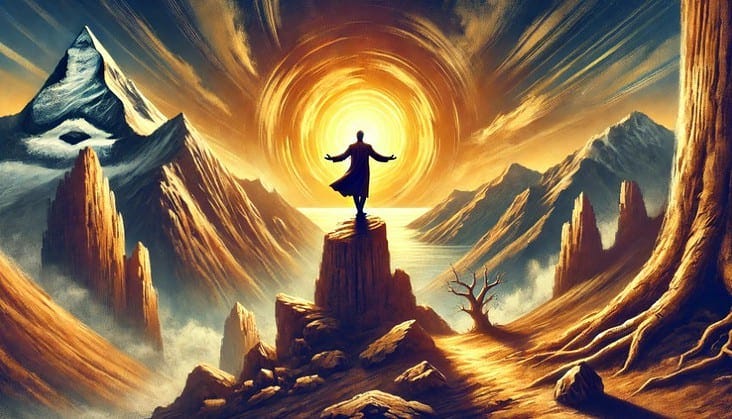
If the Eternal Return constitutes the ultimate existential test, then heroism is the mode of being required to pass it. Nietzsche’s philosophy does not merely diagnose nihilism; it demands a transformation of the human type capable of confronting it without recourse to consolation, resentment, or metaphysical escape. This transformed type is the Übermensch, a figure often misunderstood as biological or political, but properly understood as existential, psychological, and spiritual. The Übermensch embodies the internalization of the ancient heroic ideal and represents a form of apotheosis, not ascent out of the world, but mastery within it. Nietzsche introduces the Übermensch in Thus Spoke Zarathustra as a response to the collapse of traditional values, “Man is something that shall be overcome. What have you done to overcome him?”[11]
This statement is crucial. “Man,” for Nietzsche, does not denote humanity as such, but a historical and psychological configuration: the comfort-seeking, herd-oriented, security-obsessed individual shaped by the slave morality of Christianity. To overcome man is not to escape humanity, but to transfigure the human orientation toward a Dionysian life. This overcoming is inherently heroic because it requires confronting suffering, chaos, and meaninglessness without denial. Nietzsche repeatedly insists that greatness arises only through struggle, he writes, “One must need to be strong, otherwise one will never become strong.”[12] This echoes the structure of Indo-European heroic myth, where strength is not given but forged through ordeal. Yet Nietzsche relocates the ordeal inward, as the Übermensch does not slay dragons or giants; he overcomes resentment, fear of suffering, and the temptation to flee into comforting illusions. The heroic struggle becomes psychological and existential rather than cosmological. Central to this struggle is the affirmation of suffering itself. Nietzsche rejects any worldview that treats suffering as an objection to life. On the contrary, suffering becomes the condition of transformation:
What is good? All that heightens the feeling of power, the will to power, power itself in man. What is bad? All that proceeds from weakness.[13]
Suffering, when affirmed rather than denied, becomes a creative force. This is why Nietzsche attacks moral systems that seek to anesthetize pain rather than transfigure it. The Übermensch does not seek comfort; he seeks intensification of life. In this sense, heroism consists not in the absence of suffering but in the ability to use suffering as material for self-overcoming. The connection between heroism and apotheosis becomes explicit when Nietzsche speaks of value creation. In a world where transcendent values have collapsed, the Übermensch must become a creator of meaning:
To create new values that, even the lion cannot do: but to create itself freedom for new creating that can the power of the lion do.[14]
The famous sequence of the camel, lion, and child represents stages of spiritual transformation. The camel bears inherited values; the lion negates them; the child creates anew. This process mirrors ancient initiatory structures and culminates in a form of self-divinization, not in the sense of becoming a god beyond the world, but in becoming the source of value within it. Here, the language of apotheosis becomes appropriate, though Nietzsche himself avoids traditional metaphysical formulations, as he writes provocatively: “All gods are dead: now we want the Übermensch to live.”[15]
This is not a call to literal deification, but to a transfer of sacred creative power from transcendent deities to the human individual. Where ancient religions placed divinity beyond the world, Nietzsche demands that the highest values be embodied immanently, through lived affirmation. In Neoplatonic terms, this is not ascent out of multiplicity, but integration within it a reconfiguration of henosis on existential rather than metaphysical grounds. The Übermensch thus stands in structural parallel to the ancient hero who achieves apotheosis through ordeal. Heracles, after completing his labors, is admitted to Olympus; Mithras, after subduing the bull, ascends as a cosmic mediator. Nietzsche’s hero undergoes no such literal ascent, but the symbolic logic remains intact: struggle to transformation to elevation of being. The elevation, however, occurs within life itself. This interpretation is reinforced by Nietzsche’s emphasis on amor fati, which functions as the culmination of heroic affirmation, “Not merely to bear what is necessary… but to love it.”[16] To love fate is to will the Eternal Return. This is the highest test of heroism, because it demands total affirmation without remainder. The individual who can say “yes” to the infinite repetition of suffering, joy, failure, and striving has achieved what Nietzsche regards as greatness. Such a person no longer seeks justification beyond life itself. In this sense, the Übermensch represents a psychological and existential apotheosis. The individual does not escape the cycle of becoming, but becomes sovereign within it. The ancient goal of union with the divine is transformed into unity with one’s own life, fully affirmed. Nietzsche thus reconfigures the heroic path: where earlier traditions sought transcendence of the world, he demands transfiguration of one’s relation to it. Heroism, for Nietzsche, is therefore not nostalgia for mythic violence nor a rejection of suffering, but the highest form of responsibility, as the courage to live without guarantees, to affirm recurrence, and to create value where none is given. The Übermensch is the figure who embodies this responsibility fully, and in doing so, achieves a modern, immanent form of apotheosis.
The Bull and the Sun

At the heart of Mithraism lies a singular, enigmatic image: the tauroctony, depicting Mithras slaying the cosmic bull. Found in every mithraeum, from the shadowed chambers of Roman military outposts to the ornate sanctuaries of the empire’s cities, this scene is more than ritual decoration; it is a visual theology, a coded map of the cosmos, and a mirro…
Christianity, Slave Morality, and the Last Men
Having established Nietzsche’s conception of heroism and the Übermensch as an existential and psychological apotheosis, it becomes necessary to examine the primary obstacle to this transformation as Nietzsche understands it: Christianity and the morality it engenders. Nietzsche’s critique is not directed at individual believers as such, but at a moral-psychological system that, in his view, arose from weakness and has since shaped Western consciousness in ways fundamentally hostile to heroism, self-overcoming, and affirmation of life. Nietzsche’s central claim is that Christianity represents the triumph of slave morality over master morality, as in On the Genealogy of Morals, he draws a sharp distinction between these two value systems. Master morality originates among the strong, noble, and life-affirming; it defines “good” in terms of strength, vitality, courage, and excellence.[17] Slave morality, by contrast, arises among the weak and oppressed, defining “good” reactively, in opposition to what it cannot attain: “The slave revolt in morality begins when ressentiment itself becomes creative and gives birth to values.”[18] At the core of slave morality is ressentiment, a psychological state in which the individual, unable to act or overcome, instead reinterprets weakness as virtue and strength as evil. Christianity, Nietzsche argues, systematizes this inversion of values. Humility replaces greatness, obedience replaces self-mastery, and suffering is no longer something to be transformed heroically, but something to be endured passively in exchange for future reward. This moral inversion has profound existential consequences. Christianity reframes suffering as meaningful only insofar as it is compensated, either through divine justice, salvation, or an afterlife. Nietzsche attacks this logic relentlessly, “Christianity is a metaphysics of the hangman.”[19] For Nietzsche, the promise of redemption beyond life functions as a psychological narcotic. It allows individuals to avoid confronting the nihilism inherent in existence by relocating meaning outside the world. Instead of wrestling with fate, suffering, and recurrence, the Christian soul learns to wait, submit, and hope. This is precisely why Nietzsche considers Christianity hostile to heroism. Heroism requires confrontation without guarantees. Christianity, by contrast, offers what Nietzsche calls “otherworldliness” or Jenseitigkeit, a flight from life itself, “The Christian determination to find the world ugly and bad has made the world ugly and bad.”[20]
By condemning the world in favor of a transcendent beyond, Christianity cultivates what Nietzsche sees as a denial of life, an inability to say “yes” to existence as it is. This denial stands in direct opposition to amor fati and the affirmation required by the Eternal Return. The culmination of this moral and psychological trajectory appears in Nietzsche’s infamous figure of the Last Me in Thus Spoke Zarathustra. The Last Men represent the end-point of slave morality once it has shed even its religious seriousness, retaining only its pursuit of comfort, safety, and minimal pleasure:“ ‘What is love? What is creation? What is longing? What is a star?’ thus asks the last man, and he blinks.”[21] The Last Men are not tragic; they are content. They have abolished risk, hierarchy, greatness, and aspiration. They seek health, longevity, and amusement, but not transformation. In Nietzsche’s terms, they are the antithesis of the Übermensch, because they refuse the very conditions that make self-overcoming possible. Crucially, the Last Men also refuse the demon of the Eternal Return. Faced with the prospect of infinite recurrence, they recoil, not because they suffer too much, but because they have too little depth to affirm. Their lives are structured around avoidance of pain, struggle, and existential responsibility. As such, they exemplify the final triumph of slave morality, no longer animated by resentment against the strong, but by a pervasive fear of intensity itself. Nietzsche emphasizes that this condition is not imposed from without, but chosen: “They have left the regions where it was hard to live; for one needs warmth.”[22]
This warmth of comfort, security, and moral reassurance comes at the cost of greatness. The Last Men say “no” to the demon not because they are coerced, but because affirmation would require heroism. To affirm the Eternal Return would mean embracing suffering, risk, and self-transformation without hope of escape. Seen through the Platonic lens developed earlier, this refusal takes on an even deeper significance. If the demon is understood as a daimon, the guide of the soul toward self-realization and unity, then rejecting the demon is equivalent to rejecting the soul’s own call to completion. The Christian and post-Christian Last Man refuses not merely suffering, but the possibility of henosis reinterpreted existentially as unity achieved through affirmation rather than salvation. Nietzsche thus frames Christianity and its moral legacy as fundamentally anti-heroic. It does not merely fail to produce great individuals; it actively suppresses the psychological conditions necessary for greatness. By sanctifying weakness, promising redemption beyond life, and cultivating comfort over courage, slave morality ensures that most individuals will never face nihilism honestly, let alone overcome it. In contrast, Nietzsche’s philosophy demands a return to the ancient heroic posture, now internalized and psychologized. Where Christianity says “blessed are the meek,” Nietzsche demands the courage to say “yes” to life even when it offers no blessing. Where Christianity promises salvation, Nietzsche demands affirmation. And where the Last Men blink, the Übermensch stands firm before the demon and says yes, willing the Eternal Return and transforming suffering into strength. In this way, Nietzsche’s critique of Christianity is inseparable from his vision of heroism. It is not a rejection of morality per se, but a rejection of any moral system that prevents the soul from confronting existence fully and from answering the daimonic call to overcome itself.
Affirmation, Heroism, and the Daemonic Call
Nietzsche’s doctrine of the Eternal Return constitutes a radical internalization of ancient cyclical cosmologies and heroic metaphysics. Where Indo-European, Platonic, and Hindu traditions externalized the struggle with recurrence through cosmic ages, reincarnation, or mythic combat, Nietzsche compresses the entire drama into the psychological and existential life of the individual. The cycle no longer unfolds across worlds or lifetimes; it unfolds within consciousness itself. The question is no longer how the soul escapes the cycle, but whether it can affirm the cycle of nihilism without remainder. At the center of this confrontation stands Nietzsche’s demon, which this paper has interpreted as analogous to the Platonic daimon, not a malevolent tempter, but an intermediary force that reveals the soul’s true orientation toward existence. When the demon announces the Eternal Return, it does not impose meaning; it exposes it, as Nietzsche asks, would this announcement be “the greatest weight” or “the most divine affirmation?”[23] The answer discloses whether one lives in ressentiment or in strength. The Übermensch emerges as the figure capable of answering this daemonic challenge affirmatively. Nietzsche’s insistence that “man is something that must be overcome” is not a biological or political claim, but an existential one.[24] “Man,” in Nietzsche’s sense, names a mode of being defined by comfort-seeking, moral consolation, and fear of suffering. To overcome man is to overcome the psychological need for guarantees, redemption, or escape. It is to embody amor fati, the unconditional love of life as it is.
In this affirmation, Nietzsche reconfigures the ancient idea of apotheosis. Union with the divine, or henosis, is no longer achieved by ascending beyond the world, but by affirming the world in its totality. The sacred is relocated from transcendence to intensity, from salvation to creation. The hero no longer slays monsters in mythic landscapes; he overcomes nihilism, resentment, and fear within himself. Against this heroic posture, Nietzsche situates Christianity and the broader tradition of slave morality. By sanctifying weakness, promising otherworldly compensation, and anesthetizing suffering, slave morality enables the individual to avoid the confrontation demanded by Eternal Return. Thus, the Last Man’s refusal of the demon is not an act of rebellion, but of fear. It is a denial of the daemonic call that, in Platonic terms, draws the soul toward its completion. To say “no” to the demon is thus to refuse not only suffering, but the possibility of existential unity, the modern analogue of henosis. Nietzsche’s philosophy, then, does not abandon the ancient problem of cyclical existence; it intensifies it. By stripping away metaphysical escape routes, Nietzsche forces the question of meaning into the most intimate sphere of life. The Eternal Return becomes the final heroic trial, and the demon becomes the soul’s most honest guide. Whether one curses the demon or blesses it determines whether one remains among the Last Men or moves toward the Übermensch. In this sense, Nietzsche stands not as a destroyer of ancient wisdom, but as its most severe modern inheritor. He demands of the contemporary individual what myth and ritual once demanded of heroes: the courage to confront recurrence, the strength to affirm suffering, and the will to become worthy of existence itself. As Zarathustra proclaims, the task is uncompromising and unavoidable: “I love him who wants to create over and beyond himself and thus perishes.”[25] The daemonic call remains. The cycle turns. What distinguishes the heroic soul is not escape from this condition, but the capacity to say yes again and again.
[1] Eliade, Mircea . The Myth of the Eternal Return. Translated by Willard Ropes Trask, Princeton University Press, 2018.
[2] Nietzsche, Friedrich Wilhelm. The Gay Science. Translated by Walter Kaufmann, New York, Penguin Books, 1974.
[3] Plato, Apology
[4] Nietzsche, Friedrich. Thus Spoke Zarathustra : A Book for Everyone and Nobody. Translated by Graham Parkes, Oxford, Oxford University Press, 2008.
[5] Ibid
[6] Nietzsche, Thus Spoke Zarathustra.
[7] Plato, Apology
[8] Plotinus, Enneads
[9] Nietzsche, Thus Spoke Zarathustra.
[10] Friedrich Wilhelm Nietzsche. Ecce Homo : How One Becomes What One Is. Translated by R J Hollingdale, London, Penguin Books, 2004.
[11] Nietzsche, Thus Spoke Zarathustra.
[12] Nietzsche, The Gay Science.
[13] Nietzsche, Friedrich. Twilight of the Idols and the Anti-Christ. Translated by R J Hollingdale, London, Penguin Books, 1990.
[14] Nietzsche, Thus Spoke Zarathustra.
[15] Ibid
[16] Nietzsche, Ecce Homo.
[17] Nietzsche, Friedrich . The Genealogy of Morals : A Polemic. Translated by Horace Barnett Samuel, New York, Gordon Press, 1974.
[18] Ibid
[19] Nietzsche, Twilight of the Idols and the Anti-Christ.
[20] Nietzsche, The Gay Science.
[21] Nietzsche, Thus Spoke Zarathustra.
[22] Ibid
[23] Nietzsche, The Gay Science.
[24] Nietzsche, Thus Spoke Zarathustra.
[25] Ibid