
When the Dragon Returns
The Shahnameh and the Eternal Aryan Struggle Against the Lie of Darkness

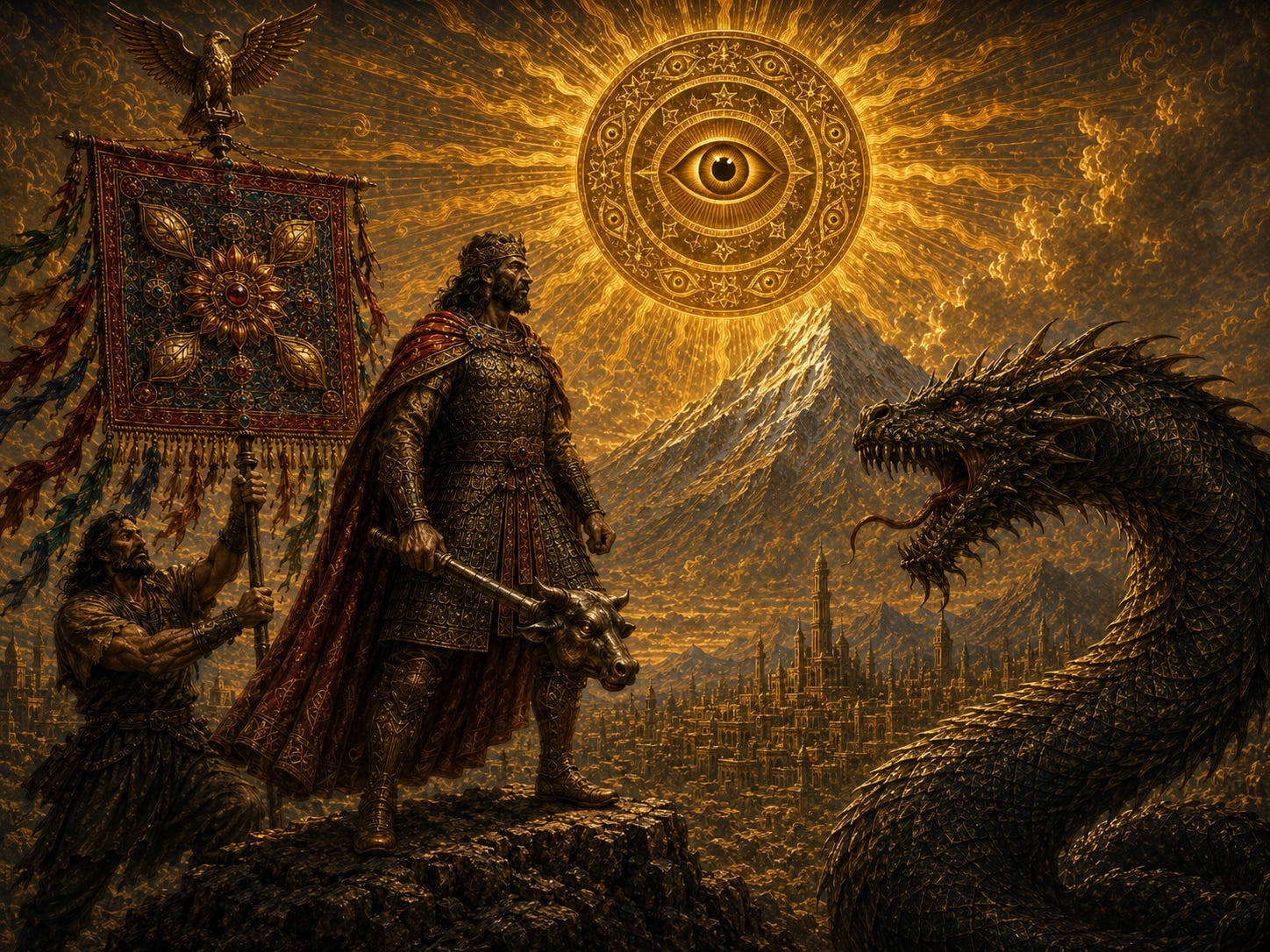
The ancient evil of dragons is remembered by all Indo-European peoples. Some legends feature dragons emerging from the sea or a dark cave, but the most terrifying dragons are not those hidden beyond the castle wall, but those seated on the throne in your own capital city.
The Persian poet Ferdowsi understood draconian despotism better than anyone else, living in an age when Iranian civilzation had been occupied by Islam. The tyrant Zahhak in the Shahnameh is described as a serpentine, evil conqueror, a devil and dragon disguised as a man, who rules the land by feeding on children’s brains. He rules Persia through fear for a thousand years, and by the end of his reign, he has not only devoured the people’s lives but also the land’s future. However, what is most interesting in this story is not how Zahhak met his end, but how he had the opportunity to enslave the land and rule over the people. Modern people often imagine tyranny as something imposed from without, as we are bombarded with ideas from pop culture of fascist and communist government over the will of free peoples that take power through war or deception, a catastrophe that descends unexpectedly upon an innocent society. Ferdowsi would like to dispense with this liberal myth, as he tells a different story: domination begins long before the conqueror arrives. Something must first be forgotten before the dragon can take power. A covenant must be broken, a people must lose confidence in the principles and virtues that once sustained them. Only then does the dragon find an open gate and the people welcome him inside. This is the enduring power of Ferdowsi’s vision, as beneath the clash of heroes and villains lies a deeper meditation on moral decline, abandonment of sovereignty, and the conditions under which a civilization willingly ceases to defend itself. Zahhak is not merely a villain from a distant age; rather, he is a warning posed to every generation: what kind of society creates the conditions in which dragons can rule?
Jamshid and the End of the Golden Age
The true beginning of the Zahhak is therefore not Zahhak at all; rather, it begins with the story of the golden-age reign of King Jamshid or King Yima from Avestan sources. Before Zahhak came with the bondage of tyranny, there was a time of divine splendor, peace, and the unification of men and gods in Aryan lands. Long before the rise of the desert serpent king, Jamshid represents the zenith of Iran's mythical glory. Not only is Jamshid a king, but he is also a founder of a civilization, as Evola would call, a Polar King.1 In Jamshid’s rule, the arts and sciences are cultivated and organized within society, crafts and professions are established, and the advancement of medicine begins. Jamshid’s rule embodies the archetype of the Golden Age, and as Ferdowsi illustrates, there is a harmony of abundance and legitimacy,
The imperial farr was his. The world submitted to him, quarrels were laid to rest...2
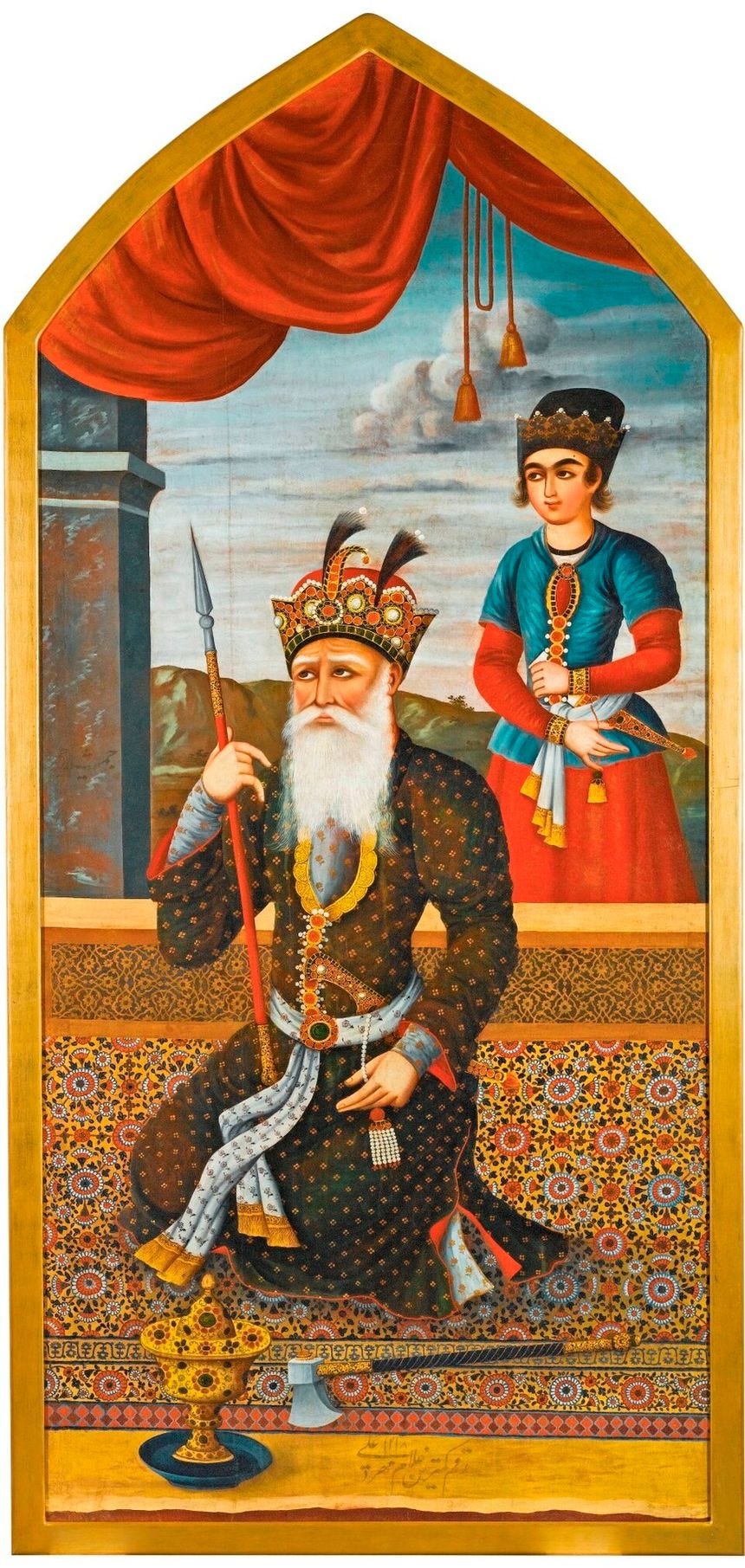
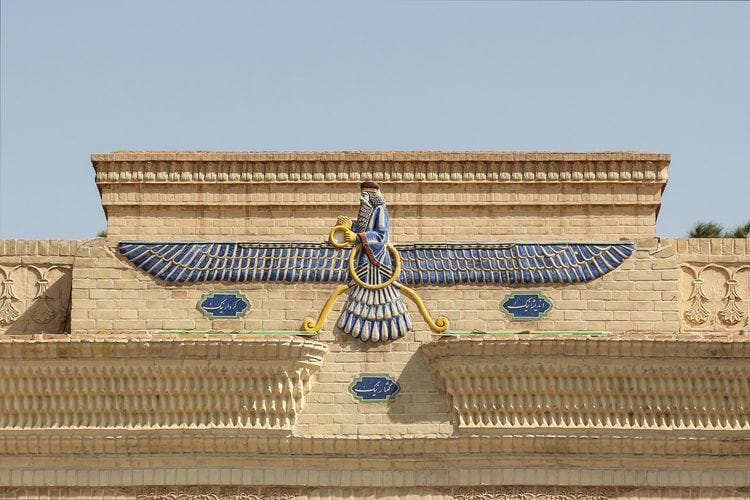
The concept of farr (Avestan khvarenah) is key to understanding what is to come, as modern readings of kingship typically focus on the leadership of great militaries or the power of a dynasty. For Ferdowsi, true kingship lies with the Farr, or divine glory. Divine glory is the source of a ruler's legitimacy and divine radiance. It is the invisible force that aligns earthly power with heavenly order. Therefore, a king rules not because he has power, but because he possesses the principle of being. In Jamshid's case, it seems that this principle is fully realized as he is described in the Shahnameh as the king who rules over a land in which suffering has all but disappeared; “Men knew nothing of sorrow or evil … and the land was filled with music.”3 This passage contains a great deal of significance that is often overlooked. The Golden Age is not to be measured by the material wealth of a kingdom, but by the harmony amongst the ruler, the people, and the divine order. Jamshid’s one mistake was that he did not believe he was a great king; he was a great king by all accounts. However, Jamshid had forgotten that his greatness came from participating in something larger than himself. Jamshid mistook the stewardship of civilization for the divine authorship of civilization. This distinction is the central drama of the story, as the fall of civilization begins with pride, or as the Greeks call it hubris, the belief that we are wiser and better than the gods. Genuinely sovereign Jamshid, after ruling for many centuries, reviewed his realm and saw no rivals. He confused gifts of the gods with his own greatness in hubris. One of the most revealing passages in the Shahnameh, written by Ferdowsi, states,
Jamshid was in a class of his own in greatness and
Visions of the world and splendors
And he who was cognizant of God
Became prouder and ungrateful
And forgot His name.4
Pride begins the path to decline, not the rise of Zahhak, but Jamshid’s fall begins with forgetting the Asha of Ahura Mazda. Modern people see hubris as a personal flaw, but Ferdowsi explains Jamshid’s decline through political and religious lenses, stating, “Such hubris cost him divine glory (farr).”5 The departure of Farr is one of the most significant examples in Iranian political theory. Before a sovereign’s power can be taken away, his right to rule must be taken away first. On the outside, Jamshid is still the king and rules over a standing throne, a standing army, and a functioning kingdom. However, Jamshid lost his rule over the civilization’s traditional soul and the god’s favor.
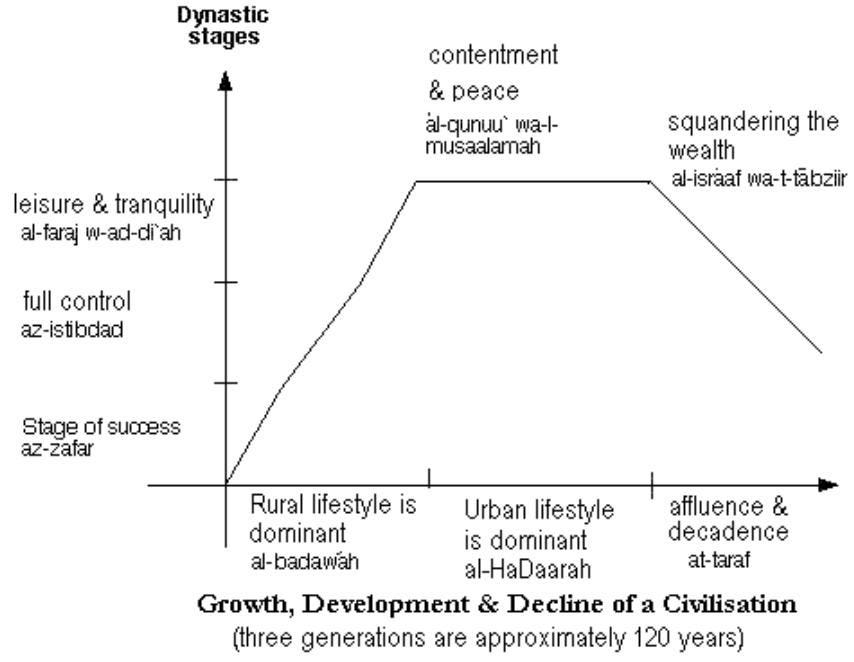
Ferdowsi’s comments seem to foreshadow a phenomenon that thinkers who lived centuries after him would adopt. One of those thinkers is the fourteenth-century Berber historian Ibn Khaldun. Khaldun argues that dynasties do not collapse solely due to foreign invasion; rather, they lose internal cohesion well before defeat.6 Increased wealth and luxury promote complacency and weaken social cohesion; therefore, a structural decay remains largely hidden until the system collapses.7
Military officer and historian John Glubb Pasha argued that civilizations decay from within before they collapse from external forces, and that internal decay happens long before external decay of the civilization’s political system.8 This is what happens in the Shahnameh: once divine glory or farr, which is related to Ahura Mazda and which entails the legitimization of divine rule, leaves Jamshid, the results do not remain confined to Jamshid. Iran, after having enjoyed so many years of peace, begins to break apart. The unity of the realm’s formal ruler, which was Jamshid, begins to erode as Ferdowsi writes, “Iran was soon filled with dissension and revolt.”9 In the Shahnameh, the loss of farr is therefore the loss of Jamshid’s throne. Jamshid still rules in a superficial sense, but the sacred legitimacy that filled his power has gone.
Ferdowsi’s account of decadence is important because it shows how decadence creates the conditions for political tyranny to be possible and for people to be willing to endure it. Zahhak does not destroy a civilization that is self-assured and confident. He inherits a civilization that is already weak, and that has lost the sovereign center of the sacred. The Dragon does not break down the walls; he approaches walls whose defenders have begun to wonder why they should continue to defend them in the first place. Therefore, the catastrophe of Iran cannot be a story of external invasion alone. Zahhak remains a tyrant of our worst dreams, and nothing about the failure of Jamshid relieves the future murderer of Jamshid of guilt, and the man who will devour the Iranian youth. However, Ferdowsi also denies the comforting notion that tyranny derives from the outside to assault an innocent and solidly unified people. Even before Zahhak has an opportunity to rule, Iran has to become a kingdom acceptable to Zahhak’s morality. This is where things come undone, as only now does the desert begin to stir. Only now does Zahhak approach the unbarred gate. When the Dragon appears before the gate, he will discover something more hazardous than a wall of a fortress having been breached, as the men on the other side have already opened the gate for him.
From the Age of Saturn to Ragnarök

Periods of civilizational crisis have often been interpreted as signs of finality: the end of an age, the exhaustion of meaning, or the collapse of order beyond recovery. Contemporary discourse, whether focused on climate catastrophe, political instability, or cultural fragmentation, frequently adopts an apocalyptic tone, suggesting that history itself …
The Devil from the Desert: Zahhak and Parasitic Sovereignty
Zahhak appears in Indo-Iranian mythology as a malevolent figure, and Ferdowsi synthesizes Zahhak into a corruption of kingship. Zahhak’s authority is established through betrayal and the destruction of innocence, whereas a genuine king’s authority is established through farr, justice, and the sacred covenant. Zahhak’s rule is not the replacement of one house by another; Zahhak’s rule symbolizes the perversion of the principles of legitimate rule.
According to the Shahnameh, Zahhak is the son of the Arab king Merdas, who ruled outside Greater Iran.10 Ferdowsi is intentional in making Zahhak a foreigner who comes to fill an internal void in Iran, as people who are internally weak are open to being easy prey to outsiders. The ethnic dimension of Ferdowsi’s narrative is that his foreignness is a part of the epic’s political symbolism. What is significant is that Zahhak rules without the moral right granted to him by the Iranian people. He is foreign, not only in a geographical sense, but in a political and cosmological sense. His power comes from outside the moral covenant that connects the king, his people, and God’s Law. Therefore, foreign rule is a more visible sign of a greater internal fracture. In Ferdowsi’s epic, it is not without significance that Zahhak’s rule is immediately after the loss of farr. In Ferdowsi’s Iran, it is not without reason that external rule is introduced with the fall of the Sassanid Empire. In the absence of internal order and legitimacy, the alien ruler does not create a vacuum of internal order; he fills it. This is reminiscent of Ibn Khaldun’s analysis of the decline of a dynasty, as Ibn Khaldun claims that the ruling family undergoes a decline of luxury and a loss of cohesiveness (ʿasabiyyah), a decline that allows a foreign dynasty to gain dominance.11 The symmetry between Ferdowsi and Ibn Khaldun is remarkable: Ferdowsi portrays luxury and the decline of order in the Iranian case with the rise of Zahhak, while Ibn Khaldun does so through the decline of cohesive force (ʿasabiyyah) and the rise of foreign domination as a result of moral decline.
To fill that void, Zahhak must first create disorder in his own house, where Ahriman approaches Him, and instead of using force, Ahriman begins his corruption by seducing Zahhak. After Ahriman gains Zahhak’s trust through flattery and secrecy, Zahhak is made obedient to him; only then does Ahriman demand that Merdas be killed. Zahhak is initially hesitant to betray his father, but his ambition outweighs his hesitation. With Merdas ruined by Ahriman’s will, Zahhak uses deceit to take what should have passed to him peacefully through something unnatural and primal. Before Zahhak becomes the Dragon of Iran, he is first the usurper of his own household.
Ahriman’s work was just beginning. In this next phase, he does not come to offer counsel, but instead comes to offer his abilities as a chef. This is fascinating because the next step occurs not through war or political intrigue, but through manipulation of appetite. Ahriman presents finer, more opulent foods, and, in turn, Zahhak is made his servant. This war of corruption is not won through deprivation, but rather through excess. Zahhak, pleased with Ahriman’s exquisite culinary skills, rewards him, and then Ahriman makes a most innocuous request for his reward: the permission to kiss the King on both shoulders, and Zahhak agrees. Ahriman kisses him and vanishes, but where Ahriman’s lips touched, two serpents appear. They cannot be removed, and whenever they are cut away, they eventually return as the serpents fuse with Zahhak’s body.
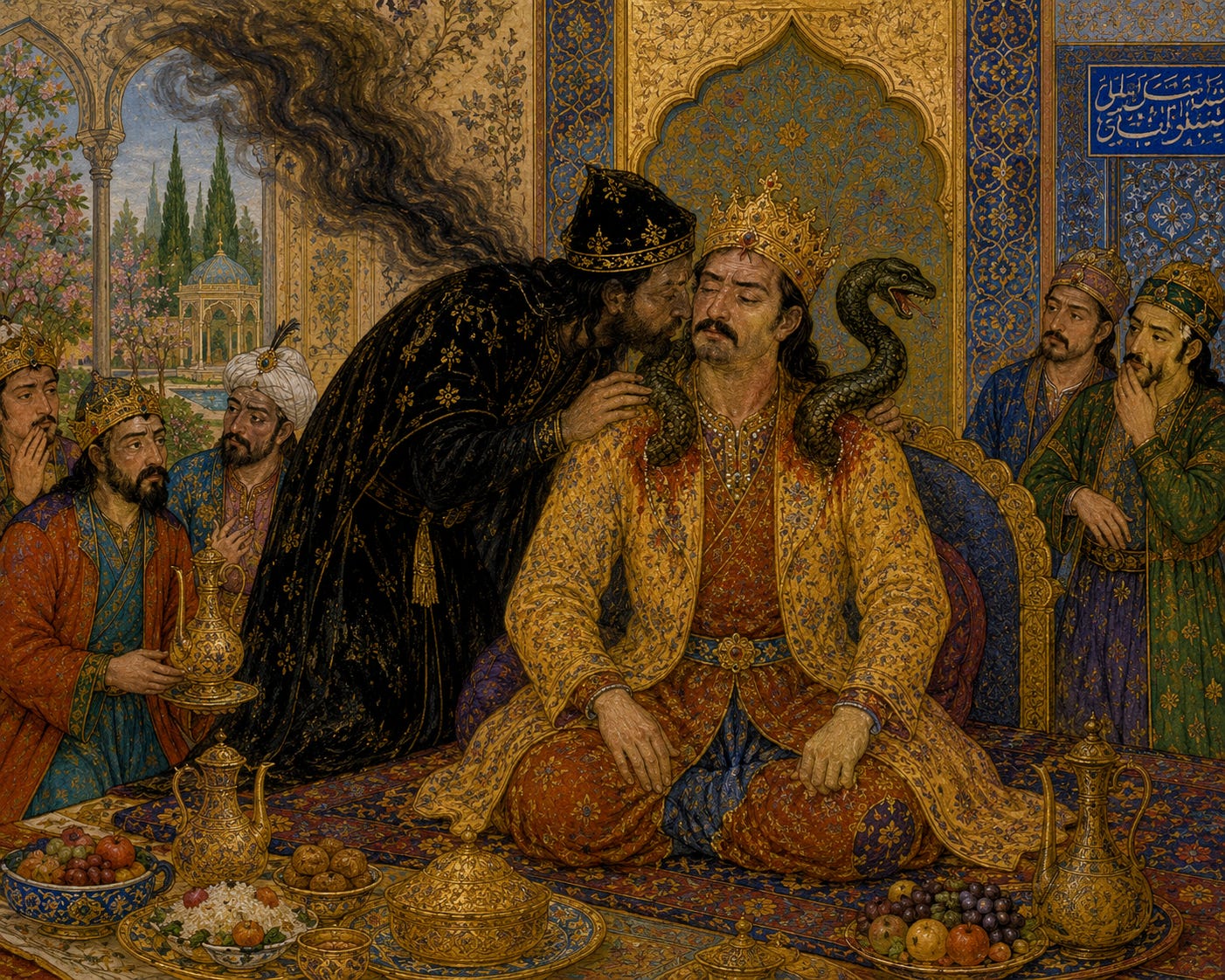
Ahriman comes again, and this time he comes dressed as a doctor. He offers to cure Zahhak of the evil he created, but he argues that the serpents cannot be removed, and the hunger of the serpents has to be satisfied.12 Ahriman further creates his trap as he created Zahhak’s hunger, and then he inscribes upon the serpents a curse of a never-ending hunger for destruction; he teaches Zahhak that, in order to live, he must destroy others by consuming the brains of childern.13 On the surface, this episode appears to be just another of the blood-curdling wonders of Medieval epics, but inside, it is one of the most symbolic and powerful images of tyranny that, to survive, it destroys a people's destiny.
At the moment, the situation in Iran is deteriorating even further. Jamshid’s nobles and warriors, who feel estranged from Jamshid since his farr has disappeared, now look to Zahhak for power and leadership. For the first time, the two plots that have so far been distinct now meet. Rather, the Iranian elite, having lost their connection to the true kingship, invite Zahhak and recognize him as king in their fight against Jamshid in a revolt. Zahhak’s victory is entirely due to Iran's internal moral collapse. Jamshid has to abandon his own kingdom and roam for many years until Zahhak’s agents eventually capture him and kill him. A civilization has now taken the place of a ruler who has lost the sacred kingship, whose rule is based on betrayal, deception, insatiable appetite, and the violence of sacrifice.
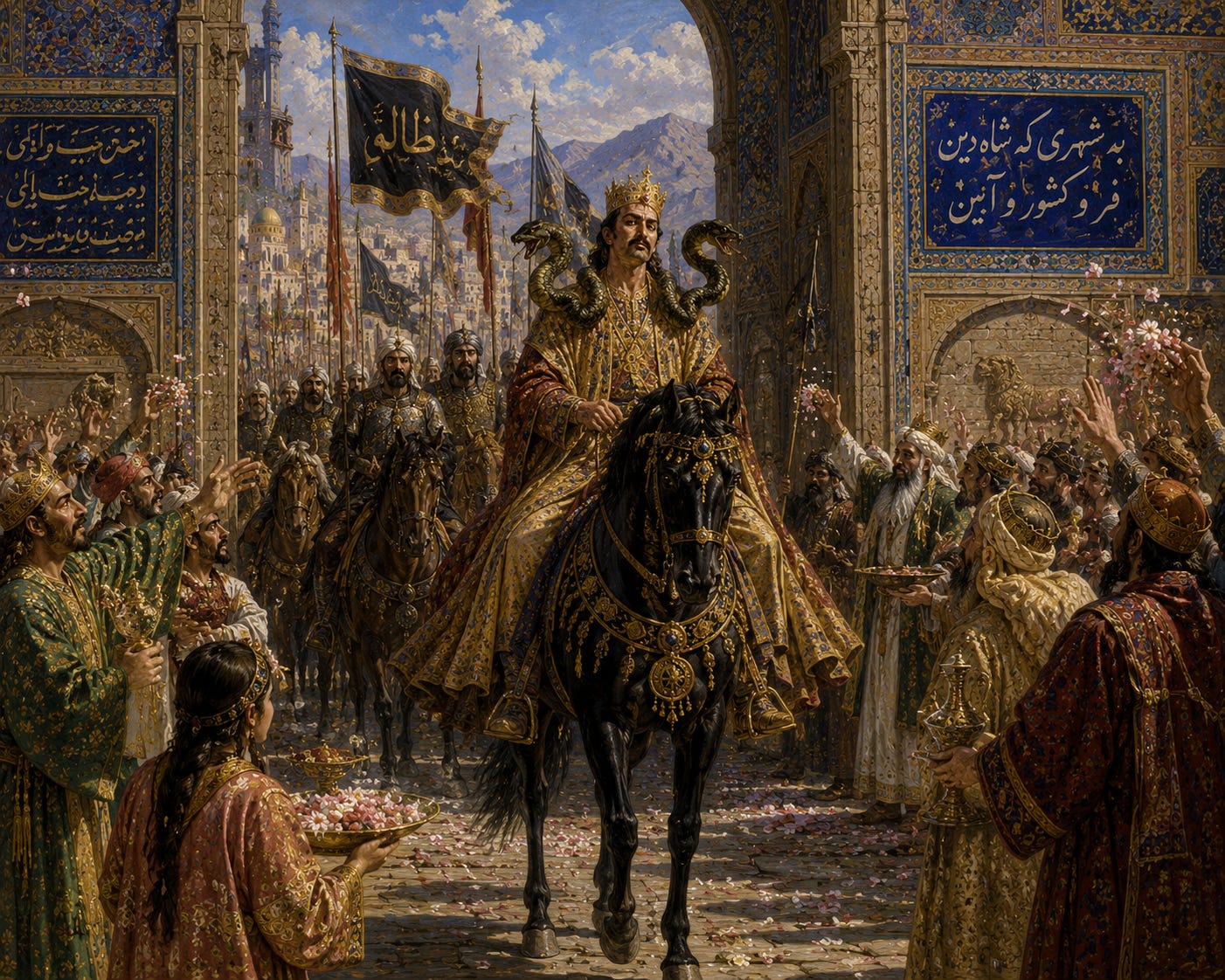
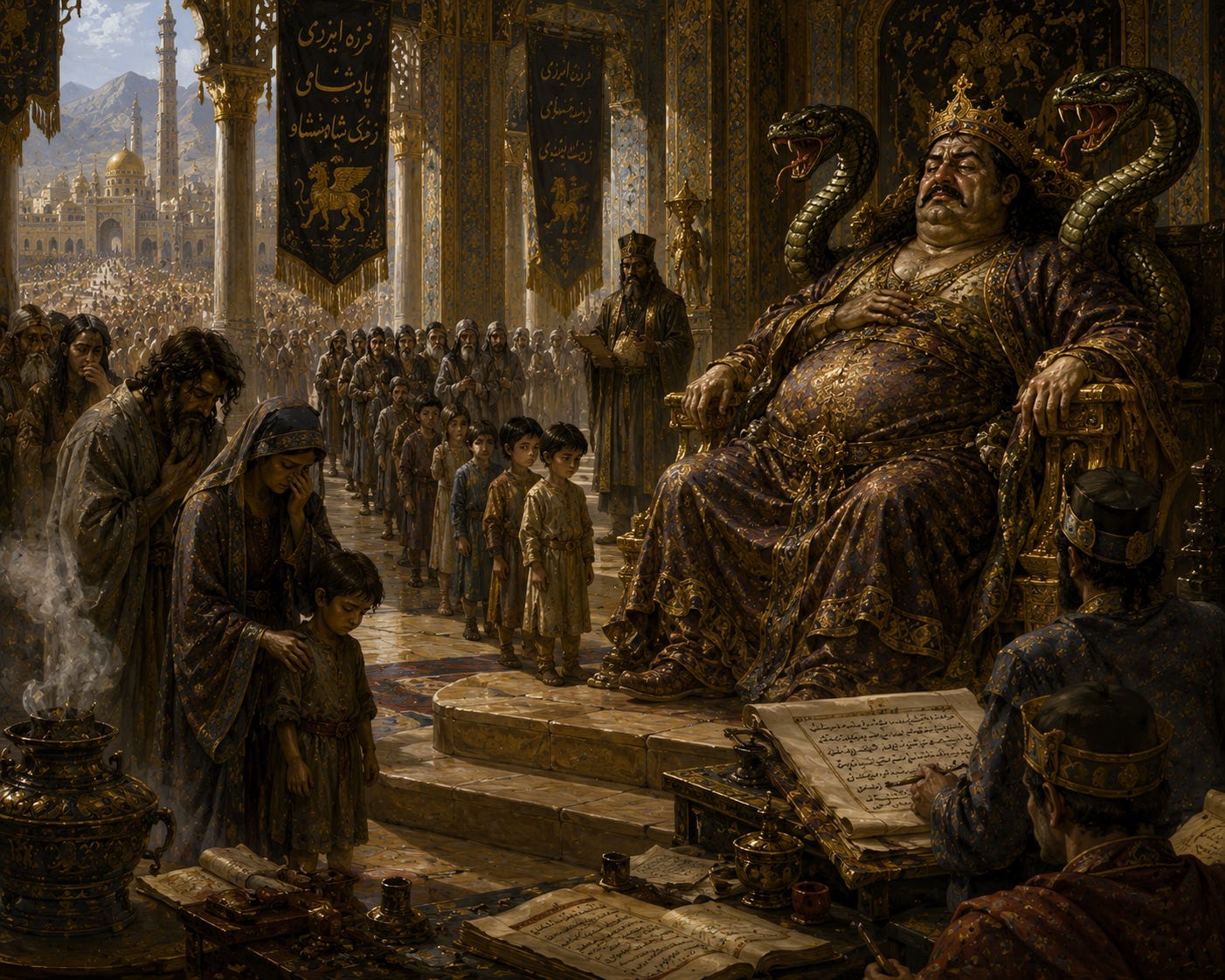
Ahriman does not place Zahhak upon Jamshid’s throne; Iran lost in moral decline does it itself. Zahhak’s tyranny is not made less significant by the destruction of those victims that now sustain his new order. They are the youth; they are the living. They are the youth that should be the future of Iran, in order for Iran to have its future fathers and craftsmen, warriors and magistrates, poets and priests, and kings. Ferdowsi makes their destruction more significant when he represents Zahhak’s unnatural appetite as consuming the very seat of human thought, meaning that Zahhak’s political oppression is the consumption of a civilization. The youth are made not to be cultivated in order to renew the civilization with their thought and vitality and courage, but are made to be sacrificed for the perpetual sustenance of the power that is destroying the civilization. Jamshid, at the height of his power, organized the Kingdom to enable the people to realize their powers and capacities. Zahhak’s inverted sovereignty, in contrast, organized society to enable the kingdom’s disease to consume the people. This marks the distinction between legitimate and illegitimate sovereignty. Thus he has made everything that is beneath his authority, as it were, fit to be consumed. The orders of the monarch stay, with the function having been inverted. What used to keep civilization alive now consumes civilization to survive, as Ferdowsi captures the politically charged atmosphere of Zahhak’s reign,
The tyrannical Zahhak reigned for a thousand years, and from end to end the world was his to command. The wise concealed themselves and their deeds, and devils achieved their heart’s desire. Virtue was despised and magic applauded, justice hid itself away while evil flourished; demons rejoiced in their wickedness, while goodness was spoken of only in secret.14
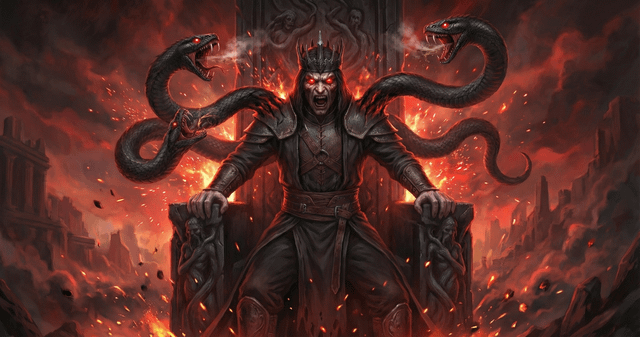
Ferdowsi does not limit his description to an oppressive government; he describes a civilization with a completely inverted hierarchy of values that is self-evident. The wise hide, justice retreats, and virtue has become an object of contempt. Evil is not merely tolerated; it is celebrated. Power enjoys a complete detachment from legitimacy.
The Banner of Kaveh: Revolt and the Restoration of Sovereignty
No tyranny lasts forever, as the Shahnameh doesn’t portray Zahhak’s millennium of tyrannical rule as a testimony of evil having no bounds. On the contrary, the longer the dragon feeds, the more swollen and painful his hunger.15 Every tyrannical regime bears the elements of its demise, because a regime that continues to exist by consuming its people will eventually consume its own foundation.
However, Ferdowsi does not commence the restoration of Iran with a prince but when the Iranians first oppose the tyranny of Zahhak, it does not come from the court, the nobles, or from power-hungry generals; instead, it comes from the workshop of Kaveh, a simple craftsman, whose life has been ruined by Zahhak’s relentless tyranny. Ferdowsi tells us that Kaveh’s seventeen sons have been sacrificed to Zahhak’s snake and that Kaveh has but one son remaining.16 Zahhak later commands Kaveh to issue a statement to proclaim Zahhak’s rule as just, and the smith refuses as Ferdowsi renders the moment simply, yet beautifully as
Kaveh tore the document apart, cast it beneath his feet and left the court in fury.17
What Kaveh did was more than an expression of rage; it was the first act of liberation. The first man brave enough to say no to the evil that had become normal. Every tyranny desires not just docility but legitimization, as no regime can exist solely on violence. It must make the oppressed believe they are justly oppressed. The document presented to Kaveh is, therefore, representative. Zahhak does not want signatures; rather, he seeks moral consent. Kaveh withholds it, and thus the spell of legitimacy is broken. For almost one thousand years, the people have been made to exist in fear, thinking that they are all alone in the desire for rebellion. Tyranny divides society by making every individual believe that he is the only one who can not see the need for rebellion. Kaveh’s rebellion shows the exact opposite, as the dictatorial oppression is revealed, individuals understand that they are no longer alone.
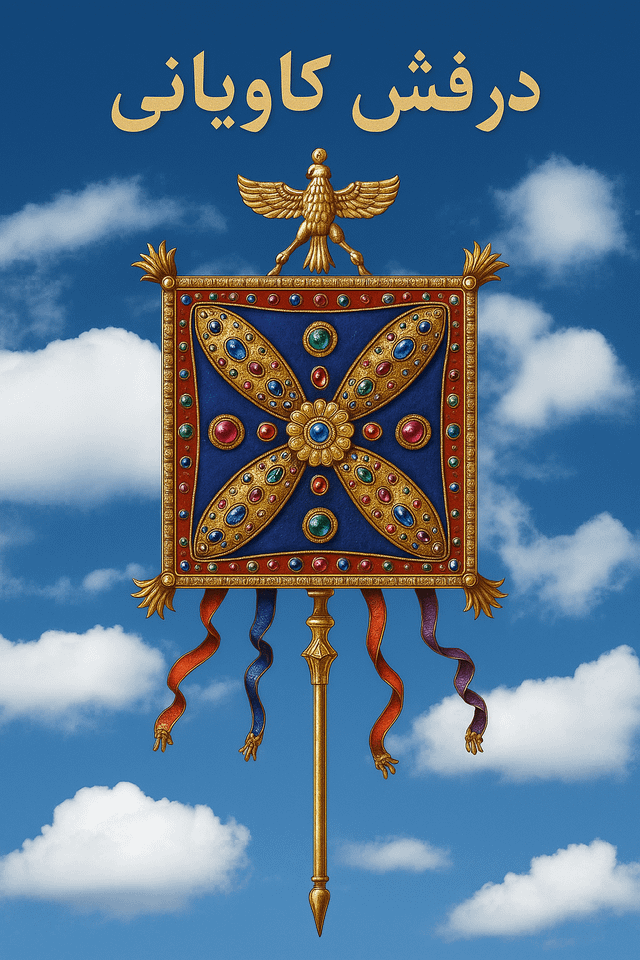
The blackened leather of Kaveh’s apron, symbolizing years of labor in the forge, becomes a banner. Ferdowsi tells that Kaveh raised his leather apron upon a spear and called the people to resist.18 What was but a moment before the humble garment of a craftsman, in that instant became the first National Liberation banner. Generations after that would add gold, jewels, and silk, transforming it into the Derafsh-e Kāviyān, the Kaveh Banner. The first and the foremost symbol of the sovereignty of the country of Iran.
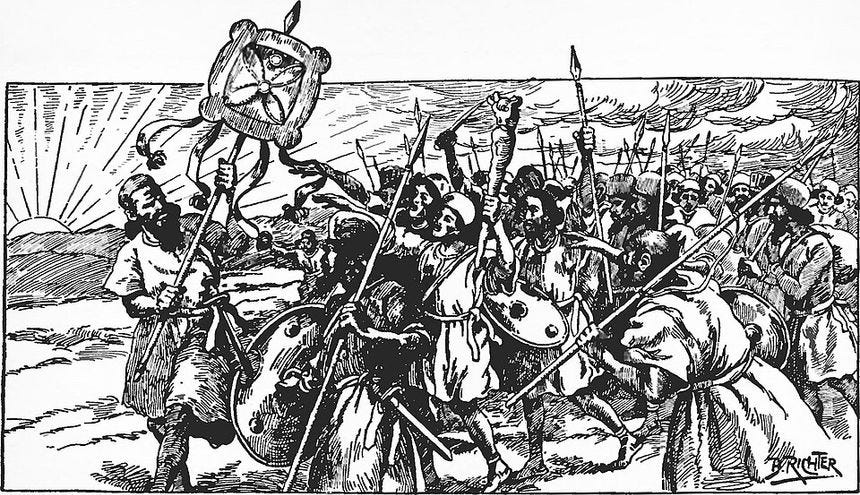
The symbolism is clear as the cosmic is restored not through luxury but through labor, not through inherited privilege but through courage and fidelity to justice. Civilization’s tools and instruments are all made with the same flame. Kaveh represents civilization as it creates and prepares a future, while Zahhak consumes the future. The blacksmith’s flag represents all the people who retained their hope in the face of the civilization’s despair and defeat. Among them is the young prince, Fereydun. Fereydun’s story begins with preservation and foreshadowing, unlike the parricidal, deceptive Zahhak. It is said that Zahhak tried to kill Fereydun as a child, before he had the chance to grow up and fulfill his fate of defeating the tyrant.19
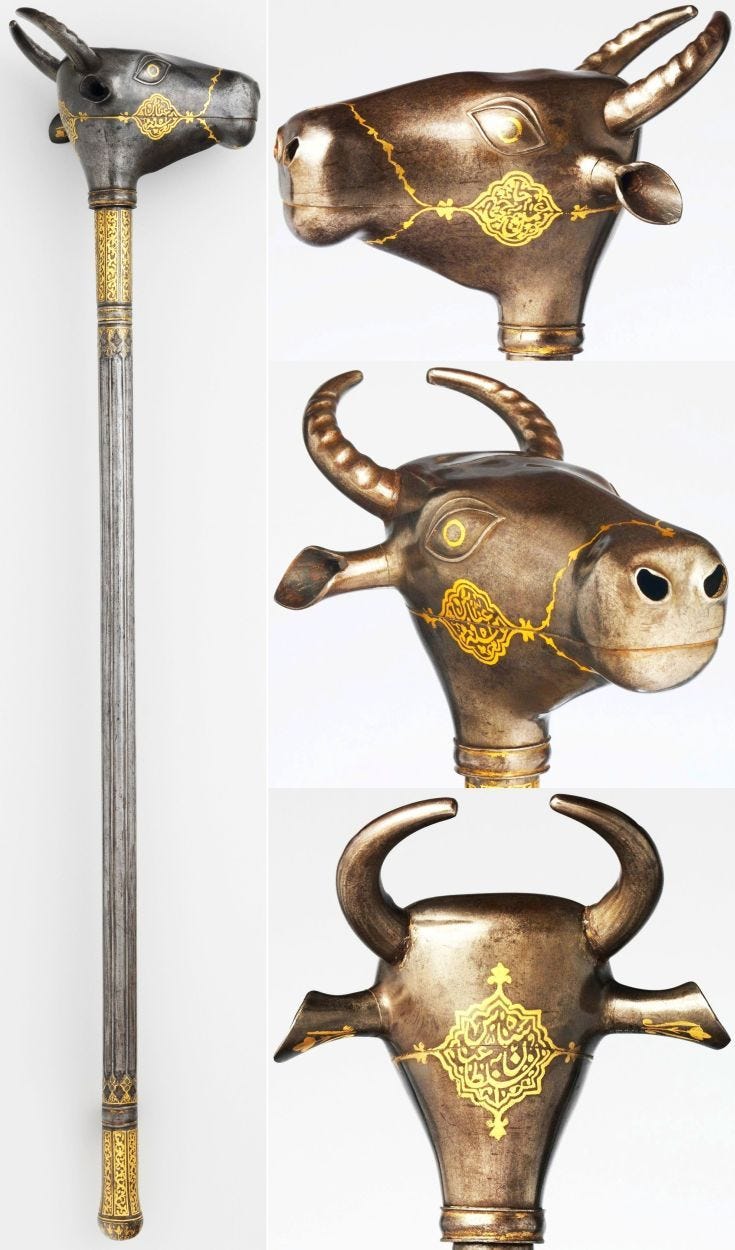
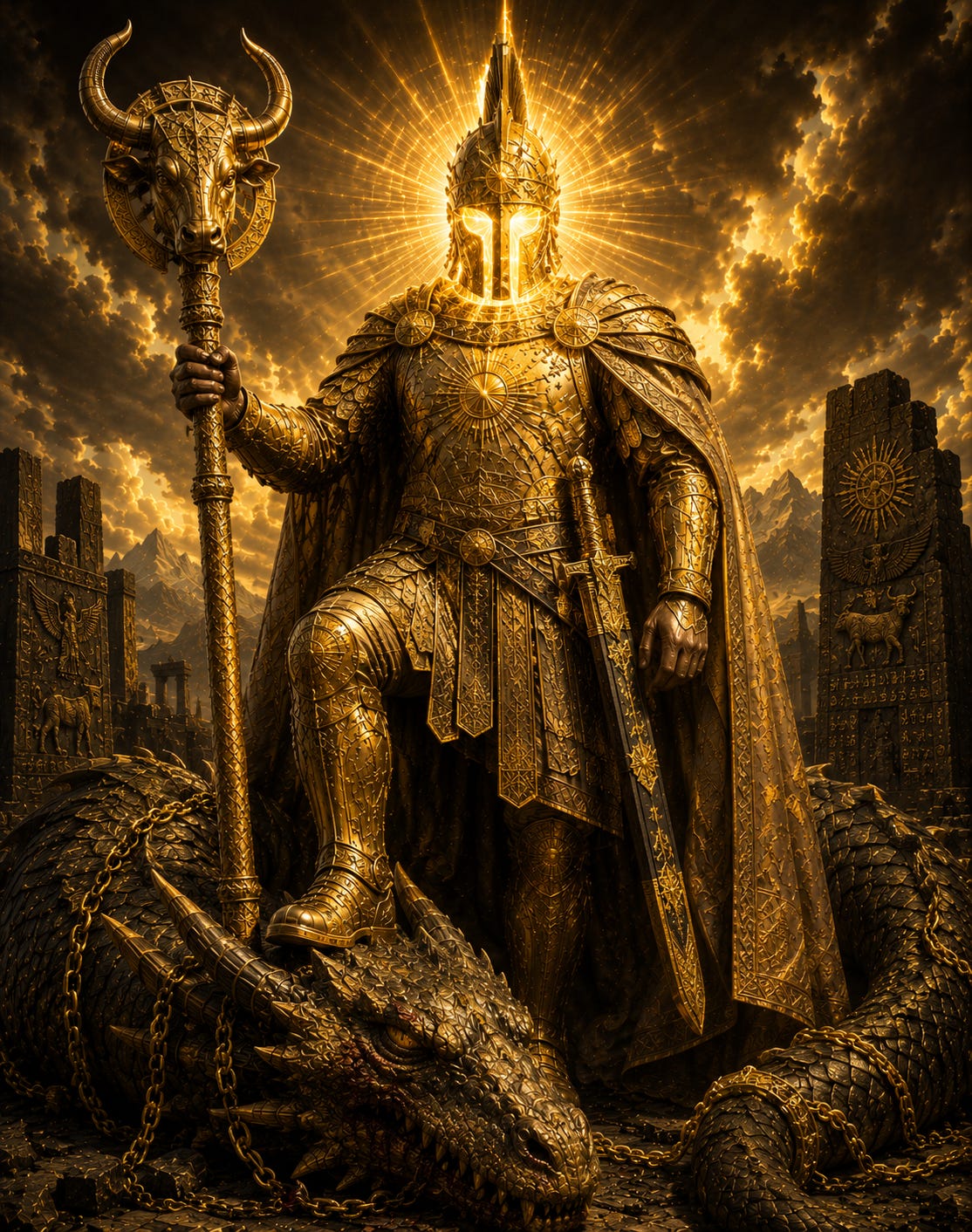
Fereydun was preserved by the people of the land, the shepherds, and guardians who risked their lives. Fereydun, upon coming of age, is presented the bull-headed mace (gorz-e gāvsār) by Kaveh to lead Iran into battle against the dragon king. The choice of the mace is no accident, as the bull is monumental in ancient Iranian religious symbolism. The bull has signified strength and fertility in Iranian tradition from the earliest times, preceding even the composition of the Shahnameh. The bull figure in ancient Iranian traditions also incorporates Mithraic and Indo-Iranian symbolism, in which the balance and regeneration of the cosmos are coupled with the idea of rightful kingship. Hence, Fereydun’s Mace is not merely a symbol of military strength, but also a symbol of order’s restoration and of rightful kingship
In this regard, Kaveh and Fereydun represent the distinct constructive aspects of politics: Kaveh emboldens the people, while Fereydun represents the aristocratic essence, the core of any elite that seeks to build a new order, together restoring the Asha of Ahura Mazda. Fereydun shows that the world's order is once again to serve a rational and ordered sovereignty. Kaveh shows that the world of rational order ultimately derives from fidelity to justice, rather than tyranny. To face down the dragon, both the people united behind a hero are both required: as for Ferdowsi, the restoration of a civilization's soul is not simply the overthrow of tyranny but the restoration of the moral condition for the golden age.
Mithra the Hidden Sun of the The Indo-Europeans Part 2: Persian Civilization

Part 1: Mithra’s Arrival in Iran, Zarathustra, and Early Persian History Before Cyrus II
Binding the Dragon: Freydun and the Restoration of the Covenant
Fereydun rises as the hero of the Iranian people, drives out Zahak’s forces, and liberates Iran; he leads an army to defeat Zahhak in his capital of Bayt al-Muqaddas, now known as Jerusalem.20
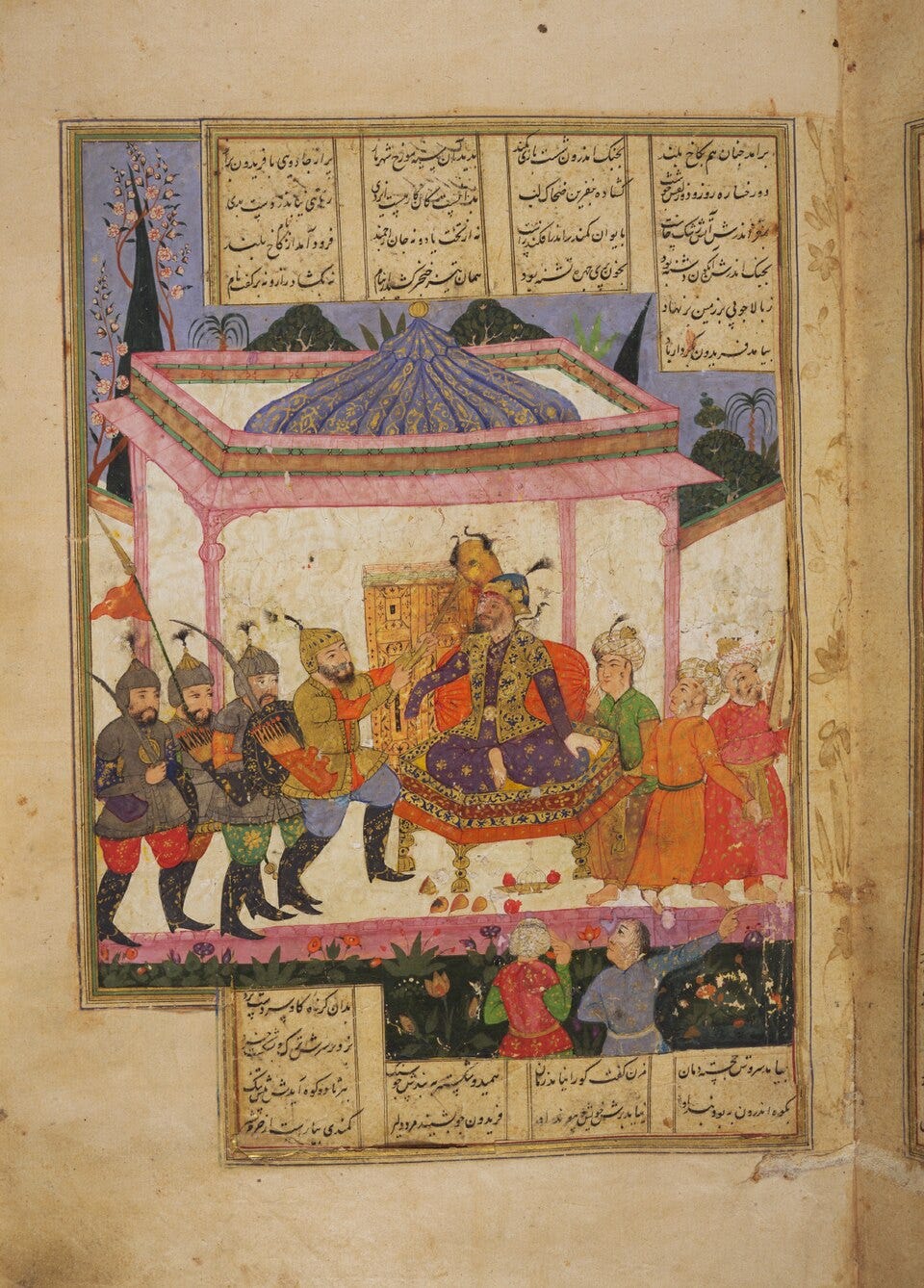
Finally, after defeating Zahhak, the Shahnameh avoids a common trope in most heroic epics: Fereydun does not simply kill the dragon, since the struggle is not only physical but also political, moral, and cosmological as when with his bull-headed mace Fereydun is about to deliver the killing blow and the Yazatas tell him that the dragon’s time has not yet come and that Frashokereti will be the day of judgment. As the evil of Ahriman does not end with Zahhak but will just migrate if Zahhak is to die. Therefore, Freydun has Zahhak bound with iron chains deep within Mount Damavand, so Ahirman's essence in Zahhak would be trapped awaiting the end of the world to be judged by Ahura Mazda.21 Thus, Fereydun’s rebellion and the liberation of Iran was successful, not merely replacing Zahhak with himself as Shah of Iran, but restoring the rightful conditions of farr to the land. Fereydun reestablishes the status of polar king of Eranshahr.

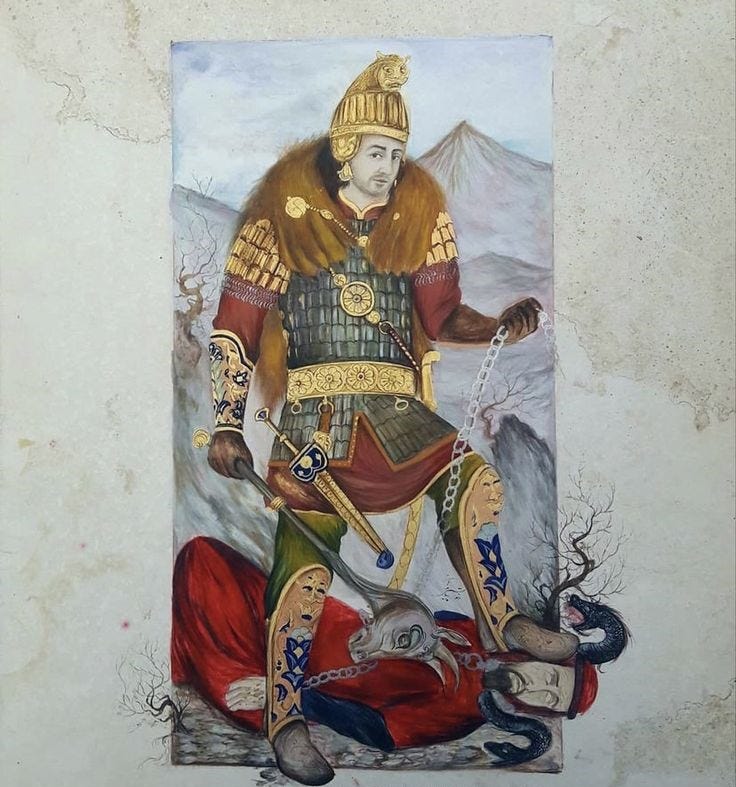
Therefore, the dragon sleeps below the mountain and waits for humanity to let down its guard and embrace it as a savior once again. Henceforth, Zahhak becomes a permanent possibility, as tyranny is a constant threat that returns throughout history whenever legitimate moral authority collapses into desire and pleasure. The imprisonment of Zahhak is, therefore, more of a warning than a conclusion, as the struggle against the dragon and the hero who must defeat him never truly ends. Each generation inherits the struggle against the dragon anew, as history is cyclical and humanity never learns from history; then we need heroes to clean up the mess of humanity’s predictable relapses in decadence. This methodological frame returns us to the beginning of the paper with the concept within the of farr. Thus, Ferdowsi presents the ethical nature of sovereignty as metaphysical before it is political, as farr cannot be achieved with power alone, nor can it be achieved with victory. Farr can only be achieved through rightful rule through participation with the divine. This idea is consistent across the Indo-European world’s understandings of the legitimacy of politics and governance as downstream from metaphysics and the gods. The modern reader asks the wrong question from stories such as this as well: “surely democracy would have prevented Zahhak's rise to the throne of Iran.” Oh, bless your heart for your draconic delusions. The dragon has already convinced you to ask the wrong question. Ferdowsi has no interest in which constitutions distribute power equitably; rather, he asks an older and more important question: by what principle does a ruler rule? What determines whether authority is divine or terrestrial and whether a ruler’s actions are defined as stewardship or predation? This is not about systems of government, but, as Plato would say, philosophy precedes the political.

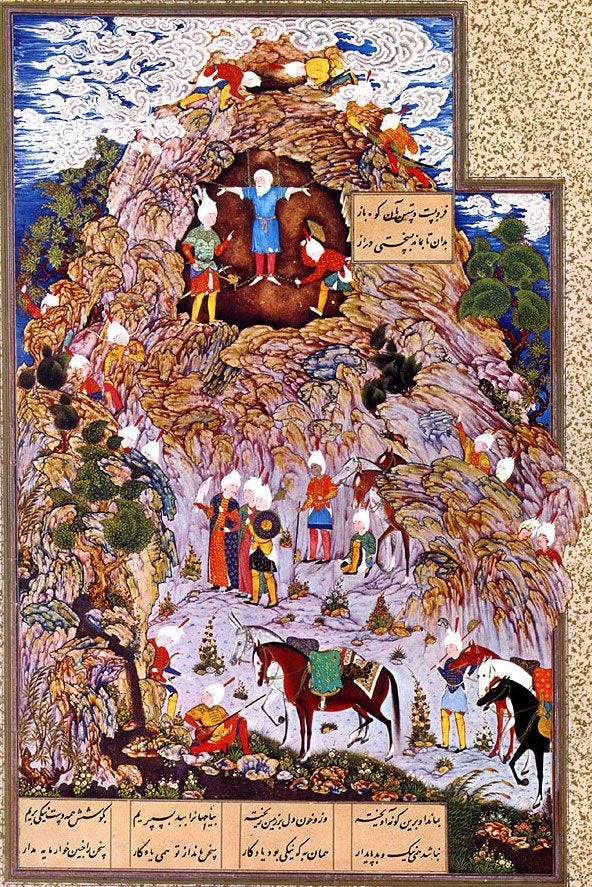
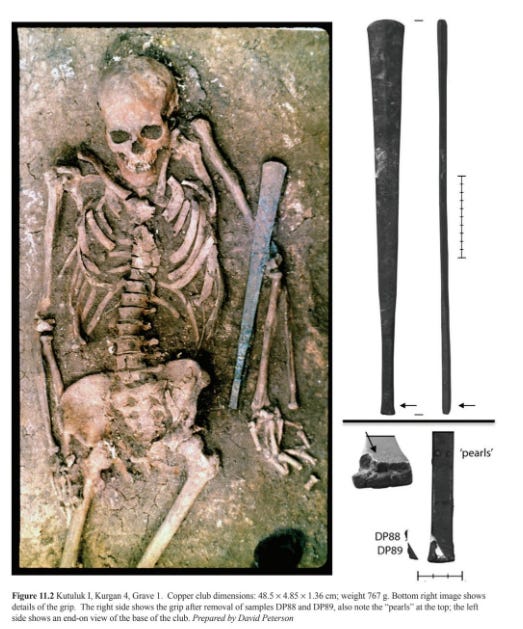
This restoration can be interpreted as part of ancient Iranian religious thought, as in Zoroastrianism, the struggle between asha and druj is played out in this tale regardless of Ferdowsi's Islamic time period. Asha represents truth and order, while druj is the corrupting lie that upsets the cosmos. Zahhak represents the victory of druj over society, while Fereydun represents the restoration of asha. The conflict is not simply ethnic or dynastic but, more importantly, the duel between Fereydun and Zahhak is metaphysical, as, for the ancient Indo-Europeans, the political and moral orders exist on the same register. Therefore, within this symbolic world, Freydun also has strong similarities to ancient Iranian sacred kingship linked to Mithra, who is the guardian of the covenant, the protector of right order, and the keeper of the bonds of society. In Ferdowsi’s narrative, Freydun is Mithraic as he clearly restores the sacred covenant of divine justice and legitimate rule. This interpretation is further supported by the symbolism of the bull-headed mace, which is not to describe the weapon as a “magical weapon”, but a symbolic and suthementaic weapon that represents order’s triumph over chaos. Hence, the bull-headed mace used to subdue the dragon, much like Heracles' club in defeating the Hydra, is more symbolic of the older Indo-European heroic ideal which defeats the dragon as an act of reestablishing the natural order.
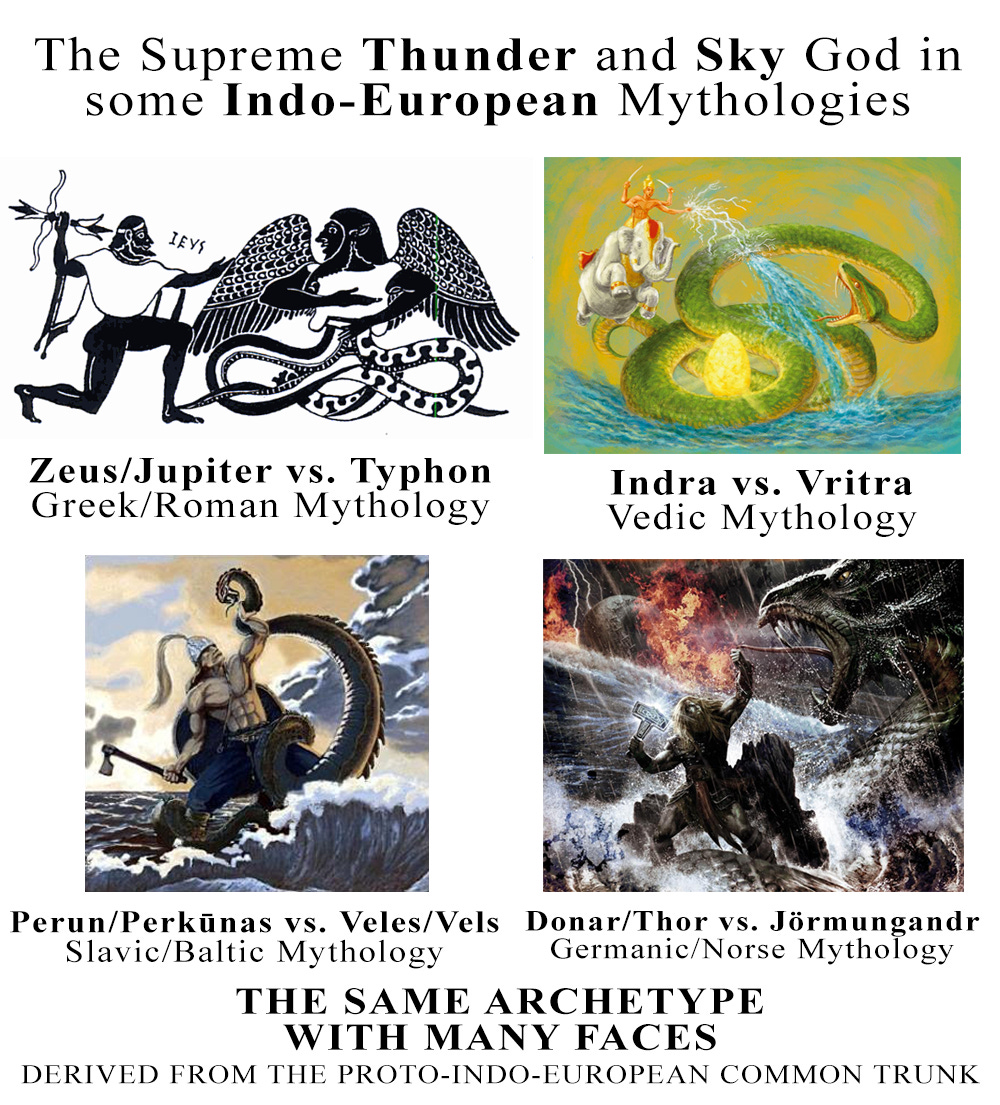
Hence, the dragon-slaying image recurs in Indo-European mythology, as discussed in a prior paper; however, Ferdowsi’s rendition is the only one in which the situation is predominantly political, as Zahhak, in this case, is King; therefore, the Dragon does not represent a wilderness monster but rather a parasitic sovereign imposed on the order of the cosmos.
The Cosmic War Against Chaos

Since the beginnings of oral and poetic traditions, humans have tended to structure literature within an archetypal framework on the Indo-European cultural matrix. Our collective understanding of the hero in European culture originates in the archetypal figure of the dragon slayer, an aspect of the broader heroic archetype that arose among the Proto-Ind…
This is why Fereydun’s triumph shows why Ferdowsi has occupied a central place in the remembrance of Iranian culture for a millennium. Ferdowsi was not a storyteller preserving antiquarian history, but a philosopher of heroism and the dangers of moral decline. However, the dragon has not disappeared; he has only been chained. The lesson of Zahhak’s imprisonment in Damavand is that tyranny and complacency will always be a danger. Whenever a civilization takes pride in itself rather than in its faith, or when rulers consume the civilization’s future, the dragon’s chains will loosen. Fereydun’s victory was not the end of history but the beginning of a duty, because it required a civilization to forge a new bond that would legitimize and strengthen moral governance. The only other outcome is the full decay of civilization and the release of a dragon that had, until then, been chained.

The Eternal Dragon and Mithra’s Champion
The Dragon was never merely Zahak; that would be too simple, a fairy tale we can forget. However, the dragon still waits beneath the mountain; thus, the question is not if but when he returns.
The Dragon has worn a thousand crowns and has spoken as many tongues. He has marched beneath forgotten banners of regimes and ideologies long made dust by history. Sometimes he comes clothed in the iron of war and other in the business suits of elections. Sometimes he demands obedience through terror, while at other times his path to power is paved by purchasing comfort and pleasure so the people feel secure and content, yet his nature has never changed.
He hungers not merely for kingdoms to wield but souls to feed on. He asks every generation the same question: Will you knell?
Hear me now, not speaking to a single Aryan people or to a single century, but as a Magus speaking across time, where the ages gathered into one eternal moment. You who stand before me with holy club of the Yamnaya, spear, sword, rifle, laptop, or empty hands, it matters not. You have all been summoned to the same holy conest. For the name of the dragon changes, but his titanic hunger does not. The hero's name changes, but their sacred duty does not.
Do not wait for Fereydun, Heracles, or St. George to be restored from oblivion by the gods, for the gods do not command the dead to return. They call upon the living to step up and examine evil. Every generation longs for another hero, another champion to rise, lead the people, and bind the dragon once more.
The Gods answer with a question of their own: Who among you will bear the Mace of Mithra? Not because Fereydun has failed but because Fereydun’s charge was never meant to end.
To be arya is not to boast of one’s ancestors; it is to become worthy of them. Arya is not inherited alone; an Arya is forged in the struggle against evil. It is proven when the lie of the dragon offers comfort, and you choose truth. When tyranny offers safety, and you choose freedom. When the dragon offers life at the price of your soul, and you refuse.
For what is the value of a long life lived upon one’s knees? What kingdom endures when its guardians of faith and war no longer guard the frontier against evil both foreign and domestic? What civilization survives once its people make peace with the Dragon’s lie? What people can remain free once they have accepted the chains that promise peace?
The serpents upon Zahhak’s shoulders are fed whenever honorable men persuade themselves that someone else will fight. No. Someone else has always been a lie. You are someone else’s someone else.
The Lord Mithras does ask you whether the odds favor you. He does not ask whether the enemy is stronger. Nor does he ask whether history will remember your name.
Lord Mithras asks, When the dragons, where do you stand? This is the eternal agon, the contest between Nomos and Chaos, between the free soul and the tyrant. Between those who will preserve the first covenant and those who will abandon it.
Mithra, guardian of covenants and witness to every oath, sees not victories of men but their fidelity. Kingdoms rise and fall, and Empire and Republic become dust. The measure of a life is not comfort, but an oath kept in the face of the dragon; that is what is remembered by the gods, not if you followed the rules or did not rock the boat.
The Gods do not honor those who seek safety above all else; they curse the coward and the traitor. They honor those who remain faithful to truth when falsehood is profitable, duty when comfort beckons, and freedom when serfdom promises peace.
The dragon will always return and so must the dragon-slayer. Not as the same man. Not beneath the same banner, but in every age those souls who refuse to bow before evil.
Then warrior of Mithras, ye later day Fredydun, Heracles, and Sirgud, like Kaveh raise the banner of revolt, like Ferydun take up the Mace of Mithra, stand in Asha, and refuse the lie with your life as you walk into the eye of the storm.
Let the dragon discover that there are still arya who can not be bought, cannot be broken, and cannot be taught to love their chains. For as long as even one soul chooses honor over comfort, truth over falsehood, and freedom over servitude, then the first covenant endures.
And if this age should ask “where is Freydun?” do not answer with words.
Let your Life be the Answer.
Grass-land magnate Mithra we worship …whom the warriors worship at the manes of their horses, requesting strength for their teams, health for themselves, much watchfulness against antagonists, ability to strike back at enemies, ability to rout lawless, hostile opponents.
-The Avestan Hymn to Mithra.
Evola, Julius. Revolt Against the Modern World. Translated by Guido Stucco, Simon and Schuster, 2018.
Ferdowsi, Abolqasem. Shahnameh: The Persian Book of Kings. Translated by Dick Davis, New York, New York, Viking Press/Penguin Group, 2006.
Ibid
Ibid
Ibid
Ibn Khaldūn. The Muqaddimah: An Introduction to History. Translated by Franz Rosenthal. Edited by N. J. Dawood. 3 vols. Princeton, NJ: Princeton University Press, 1967.
Ibid
Glubb, John Bagot. The Fate of Empires and Search for Survival. Edinburgh: Blackwood, 1978.
Ferdowsi, Shahnameh, 2006
Ibid
Ibid
Ibid
Ibid
Ibn Khaldūn. The Muqaddimah, 1967.
Ferdowsi, Shahnameh, 2006
Ibid
Ibid
Ibid
Ibid
Ibid
Ibid
This is the teaching that never ages. The dragon is not a creature of the distant past. It is a permanent possibility that returns whenever a civilization forgets the principles that once sustained it. The dragon does not break down the walls. He approaches a gate whose defenders have already opened it from the inside.
The story of Jamshid is the warning. The golden age ends not with invasion, but with hubris. The belief that greatness comes from oneself rather than from participation in something larger. The departure of divine glory is the invisible collapse that precedes every visible fall. Ibn Khaldun and Glubb Pasha echo the same truth: civilizations decay from within before they are conquered from without. The internal moral collapse is the condition that makes tyranny possible.
Kaveh's banner is the turning point. The first act of liberation comes not from a prince or a general, but from a craftsman who refuses to sign the document that legitimizes injustice. The leather apron becomes a banner. The refusal to consent is the beginning of liberation. The revolutionary potential lies not in the powerful but in the people who still remember the old covenant.
The Mithraic framework is the deeper layer. The struggle between asha and druj, truth and the lie, is the metaphysical structure beneath the political. Fereydun's bull-headed mace is not a magical weapon. It is a symbol of order's triumph over chaos. The restoration of right rule is not about replacing one king with another. It is about restoring the sacred covenant.
The call at the end is the one that matters. The gods do not command the dead to return. They call upon the living to step up. To be Arya is not to boast of ancestors. It is to become worthy of them. The dragon will always return. The dragon-slayer must always rise.
Excelente